Top 2026 Sports Equipment Tech and Smart Training Trends

Time:2026-10-17 Author:Sienna
0%

Sports equipment is entering 2026 with a sharper focus on measurable, personalized performance. Connected shoes, smart resistance machines, recovery wearables, and computer-vision cameras now turn movement into useful training feedback. The most valuable systems do not simply display numbers. They explain what changed, why it matters, and how athletes can respond safely. A runner may see cadence decline after twelve kilometers. A goalkeeper may review reaction timing frame by frame. Small details create better decisions. Yet more data does not automatically create better coaching.

This article examines the Future Of Sports Equipment Technology And Smart Training Systems through practical, evidence-aware trends. It explores adaptive platforms, embedded sensors, AI-assisted technique analysis, immersive practice tools, and equipment that adjusts resistance in real time. Coaches, sports scientists, manufacturers, and experienced athletes all provide valuable perspectives. Laboratory accuracy matters, but field reliability matters more. A sensor that fails during sweat, rain, or repeated impact cannot support serious decisions. Readers should compare calibration methods, battery life, data protection, and independent testing before trusting product claims.

The strongest innovation may feel quiet. It should fit naturally into practice. A smart racket might flag an unstable grip without interrupting a drill. A training app could reduce intensity after poor sleep, rather than reward unnecessary effort. These features may improve consistency, but they can also encourage overtraining, false confidence, or expensive dependence. That concern deserves attention. Technology should support professional judgment, not replace it. The following overview highlights promising 2026 developments while acknowledging uncertain evidence and the human skill still required to train well.
Top 2026 Sports Equipment Tech and Smart Training Trends

2026 Sports Equipment Technology: Core Innovations and Design Advances

Sports equipment technology in 2026 is moving beyond simple activity tracking. Smarter design now connects sensors, materials, and coaching feedback. The ACSM’s 2025 Worldwide Survey ranked wearable technology as the leading fitness trend. This supports a clear shift toward equipment that measures movement during real training, not only after it.

New equipment may use pressure sensors inside insoles, flexible motion bands, and handles that detect grip changes. Adaptive resistance systems can adjust load when fatigue affects technique. Haptic signals can prompt a runner to shorten a stride or a lifter to slow a repetition. Lightweight frames and modular parts also make repairs easier. However, more data does not guarantee better coaching. Sensor accuracy can change with sweat, poor fit, or unusual movement. I have seen polished dashboards hide basic technique problems. Data still needs judgment. The World Health Organization reported that 31% of adults worldwide did not meet recommended activity levels in 2022. Accessible, comfortable design remains essential.

Tips: Test equipment during real sessions. Check fit, battery life, cleaning needs, and offline functions. Prefer clear feedback over crowded metrics. Review progress with a qualified coach when possible. Calibration is often overlooked.

Top 2026 Sports Equipment Tech and Smart Training Trends

2026 Sports Equipment Technology: Core Innovations and Design Advances

The chart compares common nominal data-refresh or sampling rates used by smart sports equipment. Inertial measurement units and pressure-sensing insoles typically operate at higher frequencies because they capture rapid movement and impact changes, while heart-rate, GNSS position, cadence, and power data are commonly refreshed around once per second.

Smart Sensors and Connected Gear for Real-Time Performance Tracking

Smart sensors are changing how athletes understand effort, recovery, and technique. Embedded pressure sensors can detect foot loading, while motion units measure cadence, balance, and joint movement. Heart-rate data adds physiological context during a hard interval. The useful shift is timing. Coaches can review performance while training is still happening.

The American College of Sports Medicine’s 2025 Worldwide Survey of Fitness Trends ranked wearable technology first, drawing responses from more than 2,000 industry professionals.

IDC’s Worldwide Quarterly Wearable Device Tracker reported 537.6 million wearable devices shipped globally in 2023.

These figures show strong adoption, but adoption is not proof of accuracy. A sensor may record every stride and still misunderstand fatigue.

Details matter.

In practical sessions, connected equipment can flag a sudden cadence drop or uneven landing within seconds. That warning may prompt a shorter drill, better recovery, or a technique check. However, readings can shift with sweat, loose straps, sensor placement, and software updates. Athletes should compare device data with perceived exertion, video, and qualified coaching judgment. Real-time feedback is helpful, not absolute. I have seen athletes chase a perfect metric and lose natural movement. That is a design problem, but also a coaching mistake. Future systems should explain uncertainty clearly, protect personal data, and show why a recommendation appears.

AI-Powered Training Systems and Personalized Athlete Feedback

AI-powered training systems are moving from basic tracking toward continuous, personalized athlete feedback. The 2025 ACSM Worldwide Survey ranked wearable technology as the leading fitness trend. These devices now collect heart rate, movement, sleep, and recovery signals during ordinary sessions. A cyclist may receive a lower intensity target after a restless night. A runner may see cadence warnings through bone-conduction audio.

The numbers need careful interpretation. The World Health Organization reports that 31% of adults worldwide do not meet recommended activity levels. Smart coaching could reduce this gap by making training more understandable and responsive. However, algorithms can mistake stress for poor fitness. They can also reward effort when rest is safer. Human review still matters, especially after injury or sudden performance changes.

Personalized feedback works best when it is specific. “Slow down” is weak advice. “Reduce pace by 20 seconds per kilometer for the next five minutes” is actionable. The system should explain its reasoning, not only display a score. ACSM’s data-driven technology trend also reflects this shift toward measurable decisions. Yet data quality remains uneven. Sensors slip, users forget calibration, and athletes sometimes chase perfect numbers. The technology is useful, but not infallible.

Immersive Technologies for Simulation, Recovery, and Skill Development

Top 2026 Sports Equipment Tech and Smart Training Trends

Immersive Technologies for Simulation, Recovery, and Skill Development

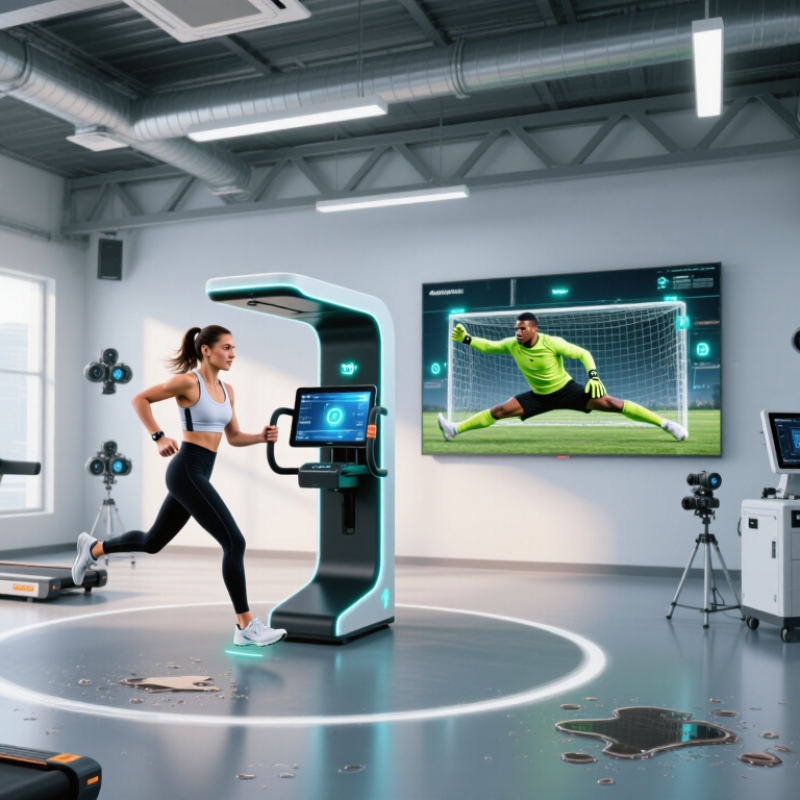
Immersive training is changing how athletes rehearse pressure without exhausting their bodies. Virtual simulations can recreate a noisy stadium, narrow lane, or fast defensive movement. Athletes respond to visual cues while motion sensors record balance, timing, and joint alignment. Coaches can review these measurements after each session. The data reveals small habits that ordinary observation may miss.

Recovery technology is becoming more responsive and personal. Compression systems, guided breathing platforms, and temperature-based tools can support post-training routines. Some systems adjust intensity according to heart rate and movement quality. Medical professionals should still review unusual pain or persistent fatigue. Technology supports recovery. It does not replace clinical judgment.

Skill development becomes more useful when feedback feels immediate. A simulated goalkeeper can change angles after every shot. A rehabilitation program can reduce virtual resistance when a knee loses control. I have found these systems engaging, but not always accurate. Sensors may shift during sweat-heavy sessions, creating misleading results. Coaches should check the equipment, compare trends, and question unexpected readings. The best training environment combines immersive practice, expert supervision, and the athlete’s own physical awareness.

Safety, Sustainability, and Data Privacy in Next-Generation Sports Equipment

Top 2026 Sports Equipment Tech and Smart Training Trends

Safety now shapes smart sports equipment from the earliest design stage. In field testing, coaches check sensor accuracy during sweat, rain, impact, and repeated washing. Sensors can fail. A sudden battery drop may hide a dangerous reading. Equipment should provide clear warnings, manual checks, and adjustable limits for different skill levels. Independent laboratories and qualified sports professionals can verify these systems before athletes rely on them. User instructions must explain errors in plain language.

Sustainability also requires more than recycled packaging. Durable fabrics, replaceable batteries, repairable joints, and modular sensors can extend equipment life. Repair matters. A cracked helmet liner or loose tracking module should not automatically mean disposal. However, manufacturers still need evidence that recycled materials preserve protection after repeated stress. This is where product testing often feels incomplete. Better repair options may increase costs, and cheaper equipment is not always the greener choice.

Data privacy becomes equally important as equipment records movement, heart rate, location, and training habits. Devices should collect only necessary information and offer visible consent controls. Consent must be visible. Secure storage, limited access, and easy deletion requests help reduce unnecessary exposure. Athletes should know whether coaches, insurers, or training platforms can view their data. More data does not always create better coaching. Sometimes, a simple performance log supports sound decisions with fewer privacy risks.

Top 2026 Sports Equipment Tech and Smart Training Trends - Safety, Sustainability, and Data Privacy in Next-Generation Sports Equipment

Trend Area Equipment and Technology 2026 Development Measurable Data Dimension User Benefit Key Safety, Sustainability, or Privacy Consideration Relevant Standard or Regulation
Adaptive Training Connected resistance machines, smart trainers, and sensor-enabled free weights Training loads adjust using performance history, fatigue indicators, movement quality, and recovery data Force, velocity, range of motion, repetitions, rest time, asymmetry, and perceived exertion More individualized workloads and earlier identification of technique deterioration Automated recommendations should remain adjustable and should not replace professional medical or coaching judgment ISO 20957 for stationary training equipment; ISO 12100 principles for machinery risk assessment
Injury Prevention Wearable motion sensors, pressure-sensing insoles, smart protective equipment, and impact monitors Real-time alerts focus on impact exposure, unstable landings, excessive joint loading, and repeated asymmetrical movement Impact count, peak acceleration, cumulative load, landing symmetry, joint angle, and exposure duration Supports safer technique correction and structured return-to-activity decisions Impact alerts are screening signals rather than medical diagnoses; false positives and missed events must be communicated clearly Product-specific protective-equipment standards; ISO 14971 principles may be relevant where software makes medical-purpose claims
AI Coaching Computer-vision coaching, voice-guided training systems, and automated session planning Models combine video, movement data, training history, and user feedback to generate technique cues Pose-estimation confidence, cue response rate, movement deviation, session completion, and model error rate Accessible guidance for home, school, rehabilitation, and community training environments Users need understandable explanations, opt-out controls, human review options, and protection against biased movement assessments EU AI Act risk-management and transparency requirements may apply depending on the system’s intended purpose and market
Recovery Monitoring Heart-rate monitors, sleep-enabled wearables, temperature sensors, and recovery dashboards Recovery recommendations increasingly combine training load with sleep, resting heart rate, heart-rate variability, and subjective wellness Resting heart rate, heart-rate variability, sleep duration, sleep regularity, skin temperature, and daily strain Helps users moderate training intensity and identify persistent fatigue patterns Physiological measurements are sensitive personal data in many jurisdictions; collection should be minimized and consent-based GDPR principles for health-related personal data; applicable national privacy laws and consumer-protection rules
Data Privacy Connected watches, training platforms, smart equipment, and cloud-based coaching applications Privacy-by-design becomes a purchasing criterion, with clearer permissions, local processing, export tools, and deletion workflows Encryption status, retention period, consent coverage, access requests, deletion completion time, and third-party sharing count Greater control over biometric, location, performance, and behavioral information Use encryption in transit and at rest, multi-factor authentication, least-privilege access, and transparent data-sharing notices GDPR; California Consumer Privacy Act as amended by the California Privacy Rights Act; ISO/IEC 27001 security-management principles
Cybersecurity Bluetooth-enabled equipment, connected displays, smart locks, and networked gym systems Secure software updates, vulnerability disclosure, device identity, and end-of-support policies become standard procurement questions Patch interval, supported lifetime, authentication method, vulnerability response time, and update success rate Reduces unauthorized access, unsafe configuration changes, and loss of training records Devices should fail safely when offline and should not depend on insecure default passwords ETSI EN 303 645 principles for consumer IoT cybersecurity; ISO/IEC 27001 governance framework
Energy Efficiency Self-powered sensors, low-energy wireless modules, regenerative cardio equipment, and efficient displays Longer battery life and energy harvesting reduce charging frequency and operating electricity demand Power consumption per training hour, battery cycle count, standby power, charging time, and energy recovered Lower maintenance workload and reduced operating costs in homes and facilities Energy claims should be measured under defined usage conditions and separated from total product life-cycle impacts EU Ecodesign principles; IEC 62301 methods for measuring standby and off-mode power consumption
Circular Materials Repairable exercise equipment, recycled polymers, recycled metals, replaceable wear parts, and modular electronics Design moves from single-product replacement toward repair, refurbishment, component replacement, and material traceability Recycled-material percentage, repair time, spare-part availability, product lifetime, and end-of-life recovery rate Extends product service life and lowers material waste Environmental claims should identify calculation boundaries and avoid vague terms such as “green” without supporting evidence ISO 14021 environmental-labeling principles; ISO 14040 and ISO 14044 life-cycle assessment frameworks
Battery Responsibility Rechargeable wearables, smart sensors, electronic safety equipment, and portable training devices Replaceable batteries, battery-health reporting, safer charging, and documented recycling routes receive greater attention Battery capacity retention, charge cycles, replacement time, thermal events, and collection or recycling rate Improves reliability while reducing premature disposal of otherwise usable equipment Charging systems should manage overheating and overcharging; damaged lithium batteries require controlled handling EU Battery Regulation 2023/1542; applicable transport and recycling requirements for lithium batteries
Inclusive Design Adjustable equipment, accessible interfaces, tactile controls, voice feedback, and adaptive training modes Equipment supports wider ranges of body size, mobility, sensory ability, age, and training experience Adjustment range, control reach, font size, contrast ratio, audio clarity, and successful task-completion rate Improves usability and reduces barriers to safe participation Accessibility should be tested with representative users rather than inferred only from technical specifications WCAG 2.2 for digital interfaces; ISO 9241-210 human-centred design principles
Interoperability Equipment using open data formats, application programming interfaces, and standardized wireless connections Users expect training data to move between compatible devices and services without unnecessary lock-in Export format, synchronization success rate, data latency, API availability, and portability of historical records Allows users and coaches to maintain a more complete training history Shared data must preserve accuracy, consent status, timestamps, and access permissions Bluetooth Core Specification; GDPR data portability principle where applicable
Evidence-Based Purchasing Smart equipment procurement for homes, schools, clubs, rehabilitation settings, and public facilities Buyers evaluate the complete product life cycle instead of focusing only on sensor quantity or app features Total cost of ownership, warranty duration, service life, repairability, data-control options, and verified safety testing Improves value, accountability, and long-term equipment reliability Marketing claims should be supported by test methods, transparent assumptions, and independently verifiable documentation ISO 9001 quality-management principles; applicable product-safety, consumer-protection, and environmental-claim laws

Measurement Notes

The listed metrics are practical evaluation dimensions for next-generation sports equipment. Actual performance depends on sensor placement, calibration, user behavior, environmental conditions, software algorithms, and the intended use of the equipment. Standards and regulations should be checked against the product category, jurisdiction, and implementation date.

FAQS

What makes sports equipment smarter in 2026?

It connects sensors, materials, and coaching feedback during real training. Pressure insoles, motion bands, and grip-sensitive handles can capture movement details.

Can smart equipment replace a qualified coach?

No. Data still needs human judgment. A polished dashboard may hide poor posture or weak technique. That is easy to forget.

How accurate are wearable sports sensors?

Accuracy can change with sweat, poor fit, rain, or unusual movement. Check calibration before training. Compare readings with physical observation.

What should athletes test before buying smart equipment?

Test it during a real session. Check fit, battery life, cleaning needs, and offline functions. Simple feedback is often better.

How can immersive technology improve skill practice?

Virtual simulations can recreate noisy stadiums, narrow lanes, or fast defensive movements. Motion sensors record balance, timing, and joint alignment. The experience can feel convincing.

Can recovery technology diagnose pain or fatigue?

No. Compression tools, breathing platforms, and temperature systems may support recovery routines. Persistent fatigue or unusual pain needs qualified medical review. Technology has limits.

What safety features should smart sports equipment include?

Equipment should provide clear warnings, manual checks, and adjustable limits. Testing should include sweat, rain, impacts, and repeated washing. Sensors can fail.

How can sports equipment become more sustainable?

Durable fabrics, replaceable batteries, repairable joints, and modular sensors can extend product life. A cracked protective liner still needs careful inspection. Repair is not always enough.

What privacy protections should connected sports equipment provide?

Devices should collect only necessary information. Users need visible consent controls, secure storage, limited access, and simple deletion requests. Know who sees the data.

Conclusion

The Future Of Sports Equipment Technology And Smart Training Systems is being shaped by lighter materials, intelligent design, and connected performance tools. In 2026, sports equipment will increasingly integrate smart sensors that monitor movement, force, balance, heart rate, and recovery in real time. These insights can help athletes and coaches identify technical weaknesses, adjust workloads, and make training more precise. AI-powered systems will analyze individual performance patterns and provide personalized feedback, allowing users to develop skills through adaptive exercises and data-driven guidance.

Immersive technologies will also support realistic simulations, rehabilitation, recovery programs, and focused skill development. At the same time, next-generation equipment will place greater emphasis on injury prevention, durable and sustainable materials, energy efficiency, and responsible manufacturing. Strong data privacy measures will be essential as connected devices collect sensitive performance information. Together, these advances will create safer, more personalized, and more efficient training experiences for athletes at different levels.

Sienna

Sienna

Sienna is a skilled marketing professional with a deep expertise in our company’s core products and services. With a passion for innovation and detail, she plays a pivotal role in crafting insightful blog posts that not only highlight the unique features of our offerings but also provide valuable......