Sports equipment rarely fails during a single dramatic moment. More often, repeated impacts, sweat, friction, sunlight, and poor storage slowly weaken its structure. A helmet may develop hidden cracks, while a racket frame loses stiffness after thousands of swings. These changes can affect safety, performance, and athlete confidence.
Sports Equipment Durability Testing Methods Explained examines seven practical methods used to measure long-term reliability. The discussion covers cyclic loading, impact testing, abrasion testing, environmental exposure, fatigue testing, corrosion assessment, and field-use evaluation. Each method reveals different weaknesses. Laboratory machines provide controlled measurements. Real athletes provide messy, valuable evidence.
Small details matter.
Reliable testing begins with clear sample selection, calibrated equipment, documented procedures, and repeatable force levels. Experienced technicians also inspect seams, fasteners, grips, shells, and internal padding after each test cycle. Relevant industry standards can guide the process, but standards cannot represent every athlete or playing condition. A controlled drop may not reproduce an awkward landing on wet grass. A climate chamber may miss damage caused by careless transport.
That limitation deserves attention. No single test proves permanent safety. Strong conclusions require several methods, honest reporting, and comparison with realistic use. This approach helps manufacturers improve designs and helps buyers understand how equipment may behave after months of demanding activity. Durability is not merely a laboratory number. It is a pattern of performance over time.
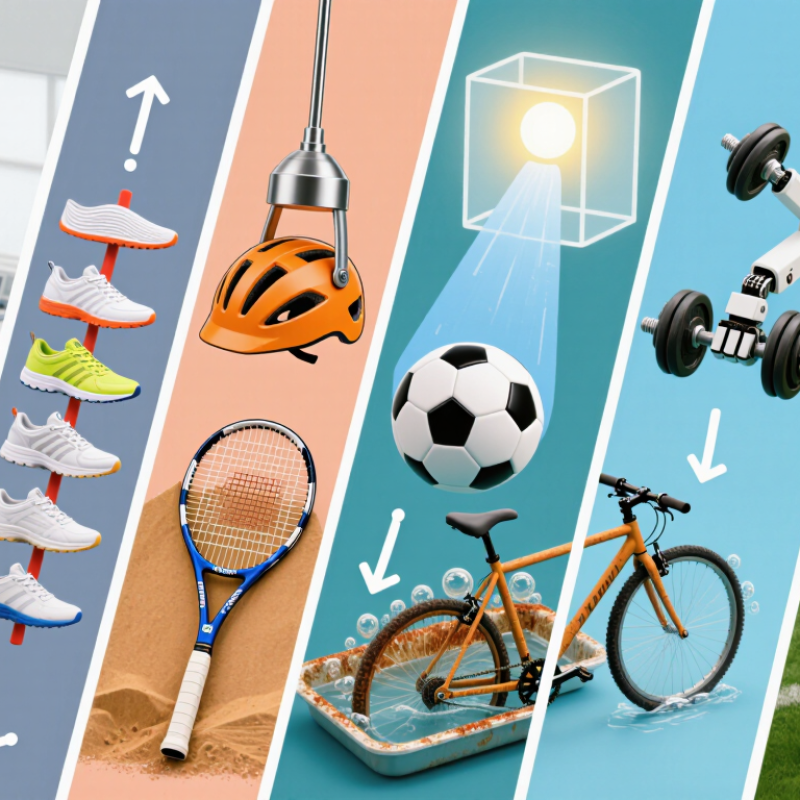
Defining Durability Requirements for Sports Equipment
Durability testing should begin with real use, not a convenient laboratory number. A training mat faces repeated compression, sweat, cleaning chemicals, and occasional dragging across rough floors. A racket faces impact, vibration, and frame distortion. The U.S. Consumer Product Safety Commission’s 2023 NEISS estimates recorded about 3.6 million injuries involving sports and recreation equipment. That figure makes failure analysis a safety task, not merely a quality exercise.
I define requirements through seven practical tests: cyclic loading, impact, abrasion, environmental conditioning, corrosion exposure, seam or fastener testing, and controlled misuse. Each test needs a measurable limit. Examples include 50,000 load cycles, a specified drop height, or less than 2 millimeters of permanent deformation. ISO 20957-1 supports structured testing for stationary training equipment, while relevant ASTM methods help establish repeatable impact and material procedures. Requirements should also reflect user weight, temperature, humidity, storage, and cleaning frequency. Laboratory results can mislead when those details are missing.
Tips: Write the use profile first. Then set load, cycle count, temperature, and failure criteria. Photograph cracks and deformation after every test stage. Review the weakest result, not the average. A perfect test plan does not exist. In my experience, teams often overtest strength and undertest sweat, stitching, or poor storage. That gap deserves honest review.
| No. | Durability Testing Method | Primary Failure Mode Evaluated | Typical Test Parameters | Key Measurements | Requirement Definition Example | Relevant Reference Methods |
|---|---|---|---|---|---|---|
| 1 | Cyclic Fatigue and Repeated-Load Testing | Cracking, loosening, permanent deformation, joint failure, and loss of structural stiffness. | Representative load profile; 0.5–2 Hz for many mechanical tests; 10,000–1,000,000 cycles depending on the expected service life. | Cycle count, force or torque, displacement, stiffness change, crack growth, and residual deformation. | No fracture or hazardous detachment; stiffness loss and permanent deformation remain within product-specific limits after the target cycle count. | ASTM E466 for force-controlled fatigue testing of metallic materials; ISO 20957 series where applicable to stationary training equipment. |
| 2 | Drop and Impact Testing | Brittle fracture, denting, delamination, hidden damage, and sudden loss of protective function. | Specified drop height, impactor mass, impact location, impact angle, and number of impacts; commonly evaluated at ambient and conditioned temperatures. | Peak force, absorbed energy, crack length, dent depth, deformation, and functional performance after impact. | No hazardous breakage or separation; impact damage and residual deformation stay below the defined safety and performance limits. | ASTM D5276 for free-fall drop testing; sport-specific helmet or protective-equipment standards should be used when applicable. |
| 3 | Abrasion and Surface-Wear Testing | Surface loss, fabric thinning, coating removal, grip reduction, and exposed reinforcement. | Controlled abrasive medium, defined pressure, fixed stroke or rotation rate, and a predetermined number of cycles. | Mass loss, thickness loss, visual grade, hole formation, color change, coefficient of friction, and seam exposure. | No hole, dangerous sharp edge, loss of grip, or exposed load-bearing layer before the specified wear endpoint. | ASTM D3884 for abrasion resistance of textile fabrics; ISO 12947 for Martindale abrasion of textile materials. |
| 4 | Tensile, Tear, Seam, and Attachment Strength Testing | Material rupture, stitch failure, strap pull-out, fastener separation, and handle detachment. | Controlled tensile loading at a specified rate using conditioned specimens and production-representative seams or attachments. | Maximum force, elongation, tear propagation, seam slippage, failure location, and residual damage. | Minimum breaking force exceeds the design load with a documented safety factor; failure should occur in the intended sacrificial component, if applicable. | ASTM D5034 or ASTM D638, selected according to the material; ISO 13935 methods for textile seam tensile strength. |
| 5 | Temperature and Humidity Conditioning | Embrittlement, softening, swelling, adhesive failure, corrosion acceleration, and performance drift. | High and low temperature exposure, humidity conditioning, thermal cycling, and recovery at standard laboratory conditions. | Dimensional change, mass change, hardness, tensile strength, impact performance, electrical function, and visual damage. | The equipment remains safe and functional across the declared storage and operating temperature range, with dimensional and strength changes within specification. | IEC 60068-2 environmental testing methods; ASTM D4332 for conditioning plastic and packaging test specimens where relevant. |
| 6 | UV, Weathering, and Outdoor Exposure Testing | Color fading, chalking, cracking, loss of tensile strength, embrittlement, and degradation of coatings or polymers. | UV radiation with controlled temperature and moisture cycles; exposure duration selected to represent the intended outdoor service environment. | Color difference, gloss, tensile retention, impact retention, surface cracking, and visual rating. | Required property retention and appearance limits are maintained after the defined exposure dose; safety-critical components must not become brittle or fractured. | ASTM G154 for fluorescent UV exposure of nonmetallic materials; ISO 4892 series for accelerated weathering of plastics. |
| 7 | Sweat, Water, Chemical, and Corrosion Resistance | Rust, staining, swelling, odor retention, adhesive degradation, electrical malfunction, and surface deterioration. | Artificial perspiration, water immersion or spray, cleaning agents, salt exposure, and repeated dry–wet cycles. | Corrosion area, mass loss, coating adhesion, color change, hardness, swelling, leakage, and post-exposure function. | No corrosion that compromises safety or operation; seals, coatings, textiles, and electronic functions remain within defined performance limits. | ASTM B117 for salt-spray exposure of metallic coatings; ISO 9227 for laboratory salt-spray testing; ISO 105-E04 for textile color fastness to perspiration. |
Real use reveals repeated compression, sweat, cleaning chemicals, impacts, and rough-floor dragging. A convenient laboratory number may miss these stresses. No test is perfect.
Common tests include cyclic loading, impact, abrasion, environmental conditioning, corrosion, seam testing, and controlled misuse. Each test should have a clear load, duration, and failure limit. Seven weaknesses.
Apply a controlled weight for a defined number of cycles. For example, test 50,000 cycles and inspect the frame after each stage. Record cracks, bending, and loose parts.
Impact testing simulates hard landings, collisions, and sudden contact. A specified drop height creates repeatable conditions. Inspect sharp edges, broken surfaces, and permanent deformation afterward.
Drag fabric, grips, or padding across a rough surface for repeated passes. Check thinning, exposed layers, loose threads, and reduced grip. Small damage can grow.
Moisture can weaken stitching, damage finishes, and accelerate metal corrosion. Use sweat-like moisture, heat, humidity, and cleaning exposure. The timing may not match real life perfectly.
Record the test method, load, cycle count, temperature, humidity, and failure location. Add calibration details and measurement uncertainty. Photographs help show cracks and deformation clearly.
Yes, static loading can reveal bending, cracking, and permanent deformation near the rated limit. Use realistic user weight and movement conditions. Overtesting strength alone is a mistake.
Compare results with the strictest applicable requirement, not merely the easiest passing level. Review gradual performance loss, not only final breaking force. Borderline results deserve another check.
Sports Equipment Durability Testing Methods Explained provides a practical framework for evaluating how well sports equipment performs over time. The process begins by defining durability requirements based on expected loads, frequency of use, environmental exposure, and user safety. Samples should then be prepared consistently, with controlled temperature, humidity, impact conditions, and testing cycles to ensure reliable comparisons.
Seven core methods can be combined for a complete assessment: repeated load testing, impact testing, abrasion and wear testing, fatigue testing, environmental exposure testing, water or moisture resistance testing, and joint or fastener strength testing. During testing, evaluators should record cracks, deformation, material loss, loosening, functional failure, and changes in performance. Results become more meaningful when they are compared with established safety, quality, and performance requirements. This structured approach helps identify weaknesses early, improve product reliability, and confirm that equipment remains safe and functional throughout its intended service life.

 IBL Sports